SoCal Forecast
Updated most Sundays, Tuesdays, and Thursdays
Sunday 10/25/26 5:55 AM
By Nathan Cool
Surf Charts for SoCal
Rincon | Ventura, C-St. | County Line | Malibu | Hermosa | Huntington BeachTrestles | Old Mans | Oceanside | Beacons | Sunset Cliffs
Subscribe to be notified:
Get notified when this report is updated.
At a glance:
Today (Sunday the 25th) is a fairly small day in the SoCal surf zone. A series of SW ground swells build during the second half of the week with bigger southern hemi over the weekend. However, we may see very strong wind swell by Sunday the 1st. Moderate NW ground swell is being watched for the 2nd-3rd. And significantly sized NW ground swell is becoming possible for the 6th-7th. Condition-wise: a potentially strong storm with heavy rain and wind could hit SoCal over the weekend; tide levels are running higher than normal; and water temps remain on the warm side.
|
|
|
Current Conditions:
Early this morning, periods were primarily running 14 seconds from 190° and 10 seconds from 310°.
Most south facing breaks were running waist to chest high. West facing spots were mostly waist high.
Buoys in the outer waters were running 5'. Nearshore buoys were running 1.6' (south facing) to 2.4' (west facing).
Water temps were running 70-73° around most of SD and OC, although Mission Beach has been reporting 68° at times over the past 24 hours. LA was running 72-74°. In VC, Channel Islands Harbor reported 69° this morning. In SB, Stearns Wharf reported 70° this morning.
Tidal Advisory: Water levels are running about 18" above normal as the Marine Heat Wave continues off Baja and SoCal. The tide tables don't account for the above normal water levels so those predictions need another 18" added to them to represent accurate levels. For example, today's 6.5' high around 9:00 AM is more along the lines of 8'. The NWS has issued coastal flood warnings and advisories for SB, VC, and LA here and OC and SD here.
Severe Storm Warning: A potentially damaging storm could hit SoCal over the coming weekend. This could create extremely strong winds, raise sea levels from storm surge, create high surf, and bring heavy rain. I'll discuss this more throughout today's forecast. Although we're in the early stages of the forecast models and there is much more to monitor over the next few days, preparations should be considered ahead of this potentially hazardous event.
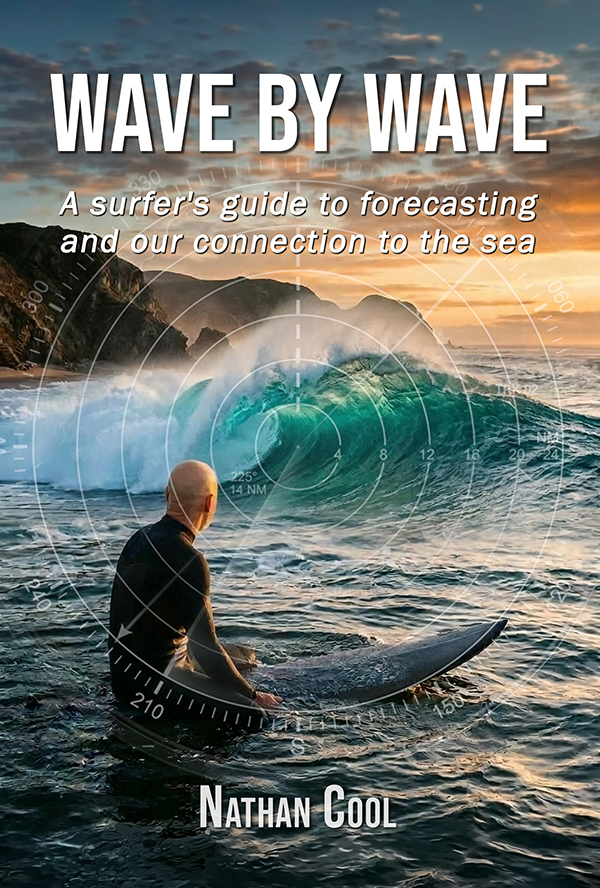
New Release: Wave By Wave
Take a journey into the hidden forces behind every swell and the ocean's connection to our human experience. After more than 30 years of tracking storms across the Pacific, Nathan Cool's latest book, Wave By Wave, takes you beyond basic swell prediction and into the deeper story behind the surf. From distant, powerful storms to the moment a wave breaks, you'll learn how to read the ocean with confidence and discover how these rhythmic forces bind us to the sea with a deeper sense of meaning.
Get the Book
Surf Forecast:
Today (Sunday the 25th) is a small day for surf in SoCal and it'll get even smaller Monday the 26th and Tuesday the 27th. Things will start to turn around during the second half of the week ahead of what could become a dangerous wave, wind, and weather event by Sunday the 1st. I'll get to that in a sec — but first things first.
Wednesday the 28th and Thursday the 29th should see initially light to moderate SW ground swell from this activity that was hugging the ice cap about a week ago (model generated by XyGrib from NCEP data):

That should produce initially waist high waves at south facing breaks Wednesday the 28th and then waist to chest Thursday the 29th with swell angled from 205-210° with periods 16 seconds.
Thursday the 29th, along with the southern hemisphere swell, we should also see light NW ground swell from this system that formed near Kamchatka a couple days ago (model generated by XyGrib from NCEP data):

That should produce waist to at times chest high waves at west facing breaks, angled from 310° and periods 15 seconds.
Friday the 30th into Saturday the 31st should see a slight boost at south facing breaks as swell comes ashore from these two systems that drifted north off Antarctica (model generated by XyGrib from NCEP data):

That should put south facing breaks into more consistent chest high sets Friday the 30th and then chest+ Saturday the 31st. Swell should be angled from 195-200° and periods 16 seconds.
BTW: Swell from Vance (originally watched for the 30th-31st) is a no-go as models have downgraded that storm and continue to keep it east of our swell window.
Saturday the 31st (building day) into Sunday the 1st (peak) should see another boost in SW ground swell from this system that recently took an ideal northerly course, directing swell toward SoCal (model generated by XyGrib from NCEP data):

On its own, that'd produce chest to head high sets to south facing breaks by Sunday the 1st, angled from 205° and periods 16-17 seconds. But this may go unnoticed as a strong weather, wind, and wave event could hit SoCal.
Sunday the 1st could see very strong WSW wind swell as this trough of low pressure dives south into — and past — the SoCal latitudes before swinging into SoCal (model by NOAA MAG):

The lows in that trough would be exceptionally strong, creating a very tight gradient that is (so far) expected to kick up powerful winds off the coast of SoCal Saturday the 31st, before making landfall with damaging winds Sunday the 1st (model by UQAM):

The red areas in those wind-gust models represent 40-45 mph gusts, which would undoubtedly cause storm surge, raising sea levels, while creating DOH wind swell waves at many south and west facing breaks. Conditions would be poor and heavy rain is being watched (more on that in the Weather section below).
Monday the 2nd would likely see this wind swell back down. By the evening, swell could come ashore from our next swell.
Tuesday the 3rd could see NW ground swell from this system that should break off Kamachatka and peak off the tip of the Aleutian Chain four days from now (model generated by XyGrib from NCEP data):

So far, that is expected to produce chest to at times head high sets at west facing breaks Tuesday the 3rd. Swell would be angled from 310° and periods 18 seconds. This swell would linger Wednesday the 4th before backing down Thursday the 5th.
Thursday the 5th (building day) into Friday the 6th (peak) could see light southern hemi from this system on the 3-day outlook (model generated by XyGrib from NCEP data):

It's not a great course for SoCal surf with just enough angular spread (page 52) to produce chest max sets at south facing breaks. Swell would be angled from 200° and periods 17 seconds.
Friday the 6th and/or Saturday the 7th could see significantly sized NW ground swell from this system diving south in the Gulf of Alaska on the 10-day models (model generated by XyGrib from NCEP data):

The preliminary models show 35'+ seas in that fetch, located a mere 1100 nautical miles from SoCal. Running the numbers (page 57), this, so far, works out to DOH sets at west facing breaks, angled from 295-300° and periods 18 seconds. This is a ways out on the long range though, making it too early to call today.
On the longer range, the marine heat wave (MHW) off Baja and SoCal continues to be an area of concern for SoCal waves and weather as it shows no sign of letting up (model from NOAA Coral Reef Watch):

That marine heat wave, which started in 2025, warmed quite a bit this summer as high pressure cooked SoCal with numerous heatwaves while northerly winds were lacking to create any cold-water upwelling. As with every El Niño, the Kelvin Waves in this year's El Niño added to this warmth; although, those were only a small part of this abnormal warmth off SoCal and Baja (more on that here). Taking a year to get to this point, the marine heat wave has become well established, and should continue for quite some time. However, we may be reaching the peak of this year's El Niño (model from NOAA CPC)

If NOAA's PDF corrected models have it right, then El Niño could be greatly weakened by the time we enter our rainiest months of January and February. But anything above 0.5°C signifies an El Niño state, so this shouldn't be taken as a downgrade right now. Instead, heavy NW ground swells and high rain remain likely over the coming months.
For the short term, the marine heat wave is the most concerning as sea levels are about 18" above normal today from the Marine Heat Wave. On top of that, we have higher than normal tides this year caused by an 18.6-year nodal lunar cycle. This lunar cycle will create higher than normal king tides for a few years, starting now. In fact, this will be quite noticeable this winter when king tides reach upwards of 7.5' around the Christmas holiday. That's the "predicted" height in the tide tables. Add another 1.5' on top of that from sea-level rise and we have a 9' high tide Christmas Eve and Christmas Day. If a storm and/or swell comes ashore then, there would be potential for storm surge adding another foot for high tide levels reaching or exceeding 10', which would inevitably cause coastal flooding and further beach erosion.
These factors increase the risk of hazards for the storm being watched for this coming weekend. I'll break down its specifics in the Weather and Wind sections below. All of this — storms, El Niño, marine heat waves, and more — need much more monitoring over the coming days, weeks, and months. But as long as I have your support then I can continue to watch the Pacific to keep you posted. Please remember this report is funded by reader donations and your help is vital to keep it alive (see why here).
|
|
|
Here's a brief look at how the next few days are breaking down so far:
Monday the 26th looks about waist high at most breaks.
Tuesday the 27th looks about waist high at most breaks.
Wednesday the 28th looks about waist to chest at south facing breaks, smaller at west facing spots.
Thursday the 29th looks about waist to chest at most breaks.
Friday the 30th looks about chest high at south facing breaks and waist to chest at west facing spots.
Saturday the 31st, so far, looks about chest to at times head high at south facing breaks. However, we may start seeing wind swell ahead of Sunday's event.
Sunday the 1st, so far, holds potential for damaging wind swell in the DOH range. Otherwise, ground swell would run chest to head high. Wind swell right now looks more likely but needs more monitoring.
Monday the 2nd, so far, is expected to see the wind swell back down, but it's too early to call that right now.
Tuesday the 3rd, so far, looks about chest to at times head high at west facing breaks (chest high more common) and chest max at south facing spots.
Wednesday the 4th, so far, looks about chest max at most breaks.
Thursday the 5th, so far, looks about waist to chest at most breaks.
Friday the 6th and/or Saturday the 7th could see powerful NW ground swell reaching DOH at west facing breaks. This is very far out on the long range models...I'll have more in my next report.
Weather Outlook:
Today (Sunday the 25th) weak high pressure is over the region and will stick around Monday the 26th. A low pressure trough passes to the north of SoCal Tuesday the 27th, increasing the onshore flow for the second half of the week. However, a stronger, more potent trough should start to make its way south Thursday the 29th. This could initially bring light, prefrontal-band rain as early as Friday the 30th and Saturday the 31st before hitting SoCal hard Sunday the 1st. It's the same trough responsible for heavy wind swell Sunday the 1st, shown here again to save you from scrolling (model by NOAA MAG):
Swinging into SoCal from the south is a major cause for concern — for a few reasons. First, strong winds could hit parts of SoCal, creating a number of wind-related hazards (model by UQAM):
The red areas in those wind-gust models represent 40-45 mph winds, which would undoubtedly raise sea level from storm surge. Winds that strong could down trees and cause other, similar damage. High surf, as discussed above, would add to the hazards. But a major issue is high rain amounts (and rates) since coming in from the south, this storm would greatly increase the orographic enhancement (see illustration on page 141). Here, for instance, are the early estimates for rain totals on the GFS (model by NOAA MAG):

If the GFS has it right, then much of SB could see 3-4" of rain; VC 1-2"; LA 0.5-1.0"; OC 0.5-1.0"; and SD 0.5". Other models differ; for instance, the ECMWF shows this storm staying at lower latitudes, bringing the bulk of its rain to OC and SD, with lighter amounts farther north.
Unlike the last storm, which was a cut-off low, the storm for this weekend has jetstream guidance. This raises confidence in the forecast. Still, it needs much more monitoring this week.
Rain will likely clear out Monday the 2nd as weak to moderate high pressure builds over the American West for at least a few days of mild weather.
Another trough is forecast to pass to the north of SoCal late next week, which could bring rain to SoCal Friday the 6th and/or Saturday the 7th. I'll see how models deal with that over the next few days.
Taking all of this into account, here's how I'm calling SoCal beach weather for the next few days:
Today (Sunday the 25th) should see a thin marine layer with quick AM burn-off and max beach temps in the mid 70s.
Monday the 26th should see a thin marine layer with quick AM burn-off and max beach temps in the low to mid 70s.
Tuesday the 27th should see a thin marine layer with quick AM burn-off and max beach temps in the low 70s.
Wednesday the 28th should see AM marine layer, mid to late AM burn-off, high clouds throughout the day, and max beach temps in the low 70s.
Thursday the 29th should see mostly cloudy skies and max beach temps in the upper 60s to low 70s.
Friday the 30th looks mostly cloudy with a chance for light precip at times, although likely trace to hundredths of an inch. Beach max temps should reach the upper 60s.
Saturday the 31st, so far, is looking at AM marine layer, high clouds most of the day, a slight chance of light rain, and beach max temps in the mid to upper 60s.
Sunday the 1st could see very heavy rain and hazardous conditions. I'll have more on that in my next report.
Wind Outlook:
Winds
at 6:00 AM were light and variable most everywhere with a slight offshore element. Afternoon onshores should run 8-12 mph.
Monday the 26th should see AM offshores 5-10 mph and afternoon onshores 15 mph, stronger at times by mid afternoon to 20 mph.
Tuesday the 27th should see AM light and variables with afternoon onshores 10-15 mph.
Wednesday the 28th should see AM light and variables with afternoon onshores 10-15 mph.
Thursday the 29th should see AM light and variables with afternoon onshores 10-15 mph.
Friday the 30th will likely see light AM onshores 4-7 mph and afternoon onshores 15-20 mph.
Saturday the 31st, so far, will likely see southerly winds pick up throughout the day, likely topping out at 15 mph in the afternoon, stronger in the evening.
Sunday the 1st, so far, has high potential for damaging winds that could gust to 40 mph along parts of the coast. I'll have more on this in my next report.
Until my next report (Tuesday), take care, be safe, and smile in the lineup!